
I still remember the first time I pulled a soil test result that genuinely humbled me. It was my third season farming my family’s 400-acre operation in central Illinois, and my corn yields were plateauing at around 160 bushels per acre despite what I thought was a solid fertility program. My agronomist at the time looked at my nitrogen application records, crossed his arms, and said, “You’re feeding your ego, not your crop.” That was my introduction to understanding ammonium nitrate — not as a bag of white granules, but as a precision tool that demands respect.
Two decades later, I’ve applied this fertilizer across thousands of acres, consulted on fertility programs for neighboring operations, and learned some lessons the hard way. Here’s what genuine field experience looks like.
The Nitrogen Advantage Is Real, But It’s Nuanced
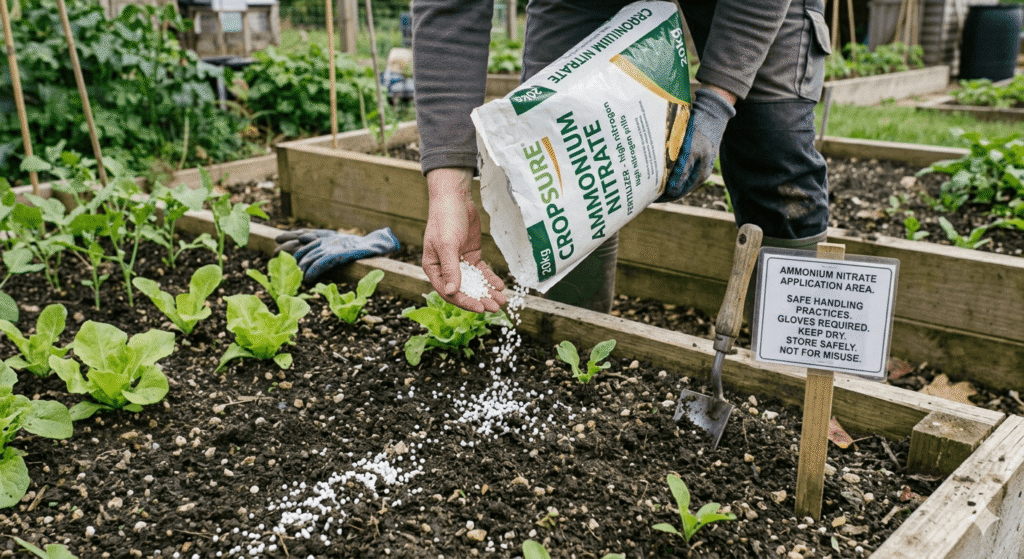
Every product sheet will tell you ammonium nitrate runs 33-34% nitrogen. What they won’t tell you is how dramatically that dual-form nitrogen — the ammonium fraction and the nitrate fraction working in tandem — behaves differently depending on your soil temperature and moisture conditions.
In my early years, I treated it like a single-speed tool. I’d broadcast in early spring and expect consistent results. What I actually got was inconsistency that took me two full seasons to trace back to timing. Cold, wet springs essentially locked up the nitrate fraction, leaving my corn with sluggish early uptake right when it needed that green-up push. Once I started tracking soil temps at four inches and holding applications until I hit a consistent 50°F threshold, my early-season color and stand uniformity improved noticeably. That’s not something you read on a label — that’s accumulated observation.
Handling It Honestly
I won’t sugarcoat this. Ammonium nitrate commands a level of seriousness that some farmers, particularly those coming from urea-heavy programs, underestimate at first. The oxidizing properties are not theoretical. Early in my career, I witnessed a storage incident at a neighboring co-op — nothing catastrophic, but enough heat generated from improperly stacked bags near a rusted metal wall to cause partial caking and a scare that resulted in an emergency call. Nobody was hurt, but the lesson was visceral.
My personal protocol has never changed since: dedicated wooden pallets, a minimum 18-inch clearance from any wall or ceiling, no fuel, oil, or organic material within the same structure, and a temperature log maintained weekly during summer storage months. My hired hands know that ammonium nitrate gets its own conversation during every spring safety meeting — not a slide in a deck, an actual conversation.
The Environmental Piece Is Where I’ve Evolved Most
In my twenties, I’ll be honest, my environmental thinking around fertilizer was basic. Apply what the crop needs, don’t obviously dump it in the ditch, move on. What changed me was watching a tile outlet on my east field run vivid green into a drainage ditch two days after a significant rainfall event following a pre-plant broadcast application. I had the nitrate-nitrogen numbers tested out of curiosity. They were not good.
That incident pushed me toward split applications almost entirely. I now apply roughly 30% of my nitrogen needs pre-plant and hold the majority for a side-dress application at V5-V6 growth stage. Yes, it costs me an extra pass. Yes, fuel and time add up. But my tile water testing over the past eight years shows a meaningful reduction in nitrate loss, and frankly, farming with a smaller environmental footprint matters to me as someone who plans to hand this ground to the next generation.
Buffer strips along my two creek-adjacent fields were another shift. Fifteen feet of perennial grass doesn’t feel like much until you watch it intercept surface flow during a two-inch May rain. It works.
What I Tell Anyone Starting Out

The farmers I’ve mentored always want to know the “right rate.” My answer frustrates them at first: there is no universal right rate, only the rate your soil test, your yield goal, your hybrid, and your weather window collectively justify. Ammonium nitrate is efficient enough that over-application doesn’t just cost you money — it actively works against you through salinity stress, leaching, and that environmental guilt that compounds over seasons.
Get your soil tested every other year at minimum. Work with a certified crop advisor who actually walks your fields, not one who mails you a recommendation from a spreadsheet. And handle this material like the serious compound it is, because the farmers who’ve had incidents are almost universally the ones who let familiarity breed complacency.
Twenty years in, ammonium nitrate remains one of the most effective nitrogen sources I use. But my respect for it has only grown — and I think that’s exactly the right relationship to have with any powerful tool.