
Best Fertilizer for Vegetables — An Expert’s Hands-On Review
I grew up in southwestern Nigeria, where my father kept a kitchen garden behind our house that seemed to produce food in defiance of logic.
The soil was sandy, the rains were unpredictable, and yet his tomatoes were legendary in the neighborhood. Years later, after earning my agronomy degree and spending over a decade advising commercial vegetable growers across West Africa, Europe, and North America, I finally understood what he had known intuitively: feeding the soil is the single most important thing a vegetable grower can do.
But understanding fertilizer truly understanding it, beyond the marketing slogans and the endless rows of brightly labeled bags takes time, trial, and a fair number of expensive mistakes.
This guide represents everything I have learned across fifteen years of hands-on practice. It is written for gardeners who want to grow exceptional vegetables, not just acceptable ones.
In 2026, the fertilizer landscape has evolved meaningfully. Biological inputs and microbiome-aware nutrition are no longer fringe concepts they are backed by a growing body of peer-reviewed research and increasingly available in practical, affordable formats.
Slow-release technologies have also improved significantly. This guide reflects the current state of the field and cuts through the noise to tell you what actually works.
Why Vegetables Have Unique Nutritional Needs
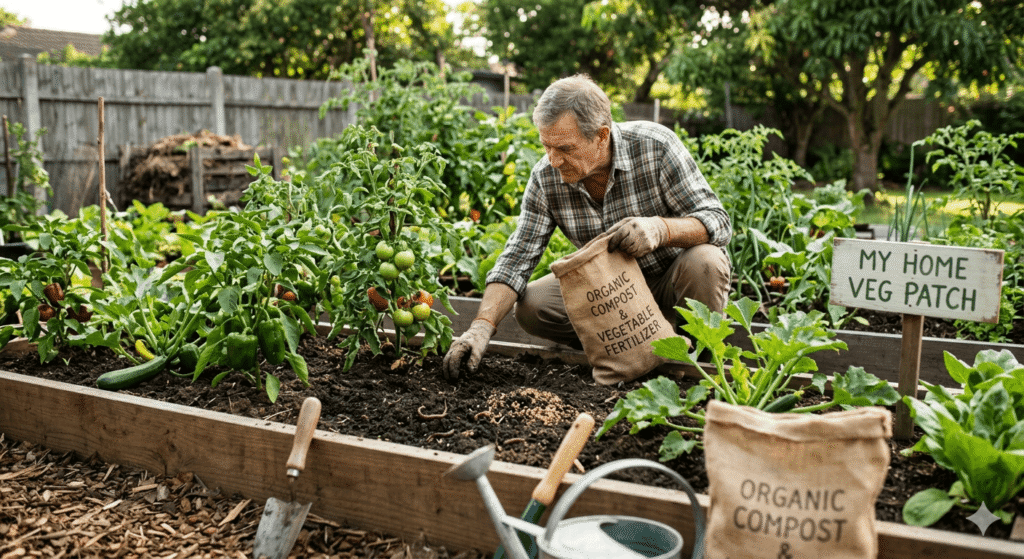
Many gardeners make the mistake of treating all plants the same. They reach for a generic all-purpose fertilizer and apply it uniformly to everything growing in the garden.
The results are almost always disappointing, because vegetables are not generic plants.
Think about what a vegetable plant is asked to do. In the span of a single growing season often just 60 to 120 days it must germinate from seed, develop a root system, build substantial vegetative structure, flower, set fruit, and ripen that fruit to edibility. In some cases, like indeterminate tomatoes, it performs all of these functions simultaneously for months on end. This is an extraordinary metabolic demand, and it requires a steady, well-timed supply of multiple nutrients to execute.
Leafy greens like lettuce, spinach, and kale are harvested entirely for their foliage and need sustained nitrogen to keep producing dark, flavorful leaves. Fruiting crops like tomatoes, peppers, and squash need a careful nutritional transition — nitrogen-forward early in the season to build vegetative structure, then a deliberate shift toward phosphorus and potassium as flowering begins. Root vegetables like carrots and beets thrive with less nitrogen and more potassium to support the development of the storage organs we actually eat.
Understanding these distinctions is the foundation of effective vegetable fertilization. Without it, even the highest-quality product will underperform.
Reading the Label: NPK and What It Actually Means
Every fertilizer product carries a three-number guaranteed analysis on its label something like 5-10-5 or 10-10-10. These numbers represent the percentage by weight of nitrogen (N), phosphorus (P expressed as P₂O₅), and potassium (K expressed as K₂O) in the product. They are the most important numbers on the bag, but they are far from the only ones that matter.
Nitrogen (N) — The Growth Driver
Nitrogen is the element most directly responsible for lush, green, vigorous growth. It is a core component of chlorophyll, the molecule that captures sunlight for photosynthesis, and of amino acids, the building blocks of plant proteins. When a plant looks pale, yellowed, and stunted, nitrogen deficiency is almost always the first suspect.
For leafy vegetables, nitrogen is the primary tool. For fruiting crops, however, too much nitrogen is genuinely destructive. I have seen entire tomato seasons ruined by well-intentioned over application of nitrogen the plants grew spectacularly to six or eight feet, produced barely a handful of fruit, and were magnets for aphids and whitefly. The lesson stuck with me permanently: nitrogen serves the leaves, not the harvest.
Phosphorus (P) — Roots, Flowers, and Fruit Set
Phosphorus drives root development, energy transfer within the plant, and the reproductive processes of flowering and fruiting.
It is most critical at two moments: when young transplants are establishing their root systems in a new growing environment, and when mature plants transition from vegetative growth to flowering and fruit production.
A classic sign of phosphorus deficiency is a reddish or purplish discoloration on the undersides of leaves, particularly noticeable on young transplants in cool spring conditions. Cold soil slows phosphorus uptake even when the element is present in adequate amounts one reason why a phosphorus-rich transplant fertilizer is valuable in early spring, when soil temperatures are still low.
Potassium (K) — The Quality and Resilience Mineral
Potassium is the nutrient I describe to clients as the one that makes everything better without being showy about it.
It regulates water movement within plant cells, strengthens cell walls, activates dozens of enzyme systems, improves drought and disease resistance, and has a direct positive effect on fruit quality, flavor, and shelf life. Vegetables grown with adequate potassium are simply better firmer, tastier, and more resilient.
Potassium deficiency is often overlooked because its symptoms marginal leaf scorch, browning leaf edges on older leaves are sometimes attributed to drought or heat stress. It is particularly common in sandy, light soils that drain and leach freely, and in intensively managed raised bed gardens where nutrients are consumed rapidly.
Beyond NPK: The Nutrients Most Gardeners Overlook
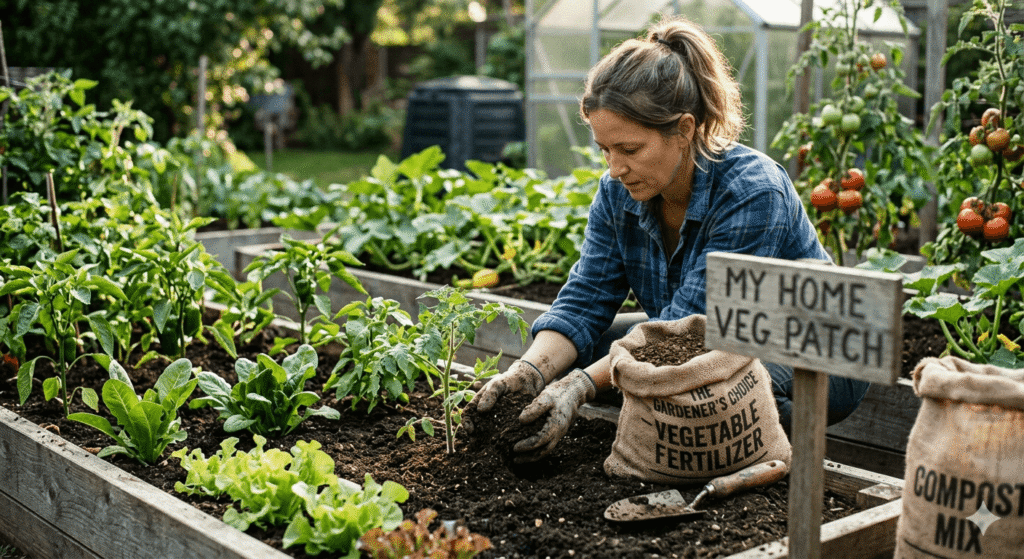
One of the most common misconceptions I encounter is that NPK is all there is to fertilization. In reality, vegetables require seventeen essential nutrients for healthy growth, and deficiencies in secondary or trace elements can be just as devastating as NPK shortfalls sometimes more so, because they are harder to diagnose.
Calcium is essential for cell wall integrity. Its deficiency causes blossom end rot in tomatoes and peppers that familiar dark, sunken patch on the bottom of the fruit that ruins so many home harvests. Crucially, blossom end rot is not always caused by calcium-poor soil; it is often caused by irregular watering that disrupts calcium uptake even when the element is present in adequate amounts. But in soils that are genuinely calcium deficient, no amount of watering consistency will prevent it.
Magnesium is the central atom of the chlorophyll molecule. Its deficiency produces interveinal chlorosis ,the characteristic pattern where leaf tissue between the veins turns yellow while the veins themselves remain green.
This is especially common in acidic soils and in intensive production systems where magnesium is depleted faster than it is replaced.
Boron, zinc, iron, and manganese are required only in trace amounts but are involved in critical enzyme systems and structural processes.
Boron deficiency causes hollow stems in brassicas and poor fruit set in many crops.
Iron deficiency produces chlorosis in young leaves.
These problems are frequently misdiagnosed as nitrogen deficiency and treated with nitrogen, which makes the actual problem worse.
A high-quality vegetable fertilizer addresses these secondary and micro nutrients, not just NPK.
When you evaluate products, always read the full guaranteed analysis panel on the back of the label, not just the three headline numbers.
Organic vs. Synthetic Fertilizer: A Practical Assessment
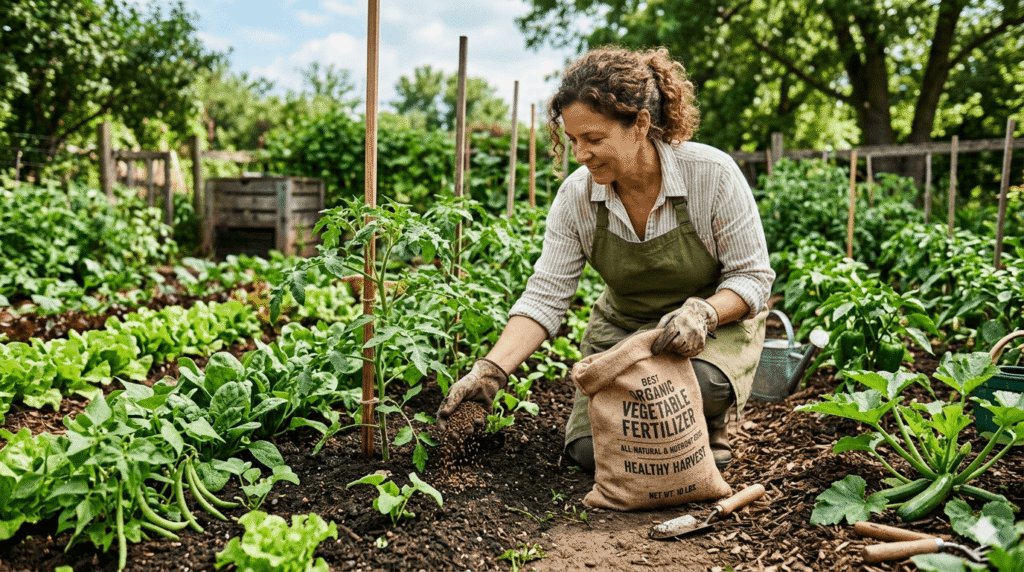
The organic versus synthetic debate generates more heat than light in most gardening discussions. My perspective, shaped by fifteen years of field work across a wide range of growing systems, is that both have genuine merits and real limitations and that the most effective approach usually involves using them together intelligently.
The Case for Organic Fertilizers
Organic fertilizers products derived from plant, animal, or mineral sources release nutrients slowly as soil microorganisms break them down.
This slow release provides a sustained nutritional background that mirrors how nutrients become available in healthy natural ecosystems. Organic matter improves soil structure, water retention, and aeration. And crucially, it feeds the soil microbial community that is responsible for nutrient cycling, disease suppression, and the production of plant-growth-promoting compounds.
The long-term trajectory of a garden managed primarily with organic inputs is consistently upward: each season, soil health improves, nutrient availability increases, and plant performance becomes more reliable. I have seen degraded, compacted, nutrient-poor garden plots transformed over three to five seasons of consistent organic management into remarkably productive growing environments.
The main limitation of organic fertilizers is their dependency on biological activity for nutrient release.
In cold spring soils, when temperatures are below 50°F, microbial activity slows dramatically, and the nutrients locked in organic materials may simply not be available when young transplants need them most.
This is a practical constraint that matters in northern climates with long, cold springs.
The Case for Synthetic Fertilizers
Synthetic fertilizers provide nutrients in immediately plant-available mineral forms, independent of soil temperature or biological activity.
This precision and speed make them invaluable for correcting acute deficiencies mid-season, for supplying nutrients in environments where organic matter decomposition is slow or unreliable, and for growers who need predictable, consistent nutritional input.
The well-documented downsides include rapid leaching from soil particularly problematic in high rainfall climates or heavily irrigated systems the risk of salt burn when over-applied, and the long term impact of exclusive synthetic use on soil biology and structure.
These are real concerns, but they are manageable with responsible use rather than reasons for blanket avoidance.
The Integrated Approach
My recommendation for most vegetable gardeners is a foundation of organic nutrition compost, aged manure, and organic granular fertilizers worked into the soil at the start of the season combined with responsive liquid feeding during peak growth periods.
This approach builds long-term soil health while maintaining the flexibility to address specific nutritional needs quickly and precisely.
Top Fertilizer Picks for Vegetables in 2026
The following recommendations are based on my direct field experience, comparative evaluation across multiple growing seasons, and assessment against the criteria that genuinely matter for vegetable production.
These are product categories and types I trust, along with specific examples I have evaluated personally.
1. Balanced Organic Granular Fertilizer — Best Foundation for Any Vegetable Garden
A well-formulated organic granular fertilizer with an NPK in the range of 3-4-4 to 5-5-5 is the cornerstone of any vegetable nutrition program.
Products in this category typically derived from feather meal, bone meal, kelp, alfalfa, and composted manures provide a broad nutritional spectrum, improve soil biology, and release nutrients gradually over the season.
The best products in this category also include biological inoculants: beneficial bacteria and mycorrhizal fungi that colonize the root zone and extend the plant’s effective nutrient uptake surface area.
In my field comparisons, plants established in soil treated with a biologically enhanced organic granular consistently outperform those given equivalent amounts of plain NPK fertilizer, particularly during stress periods like heat waves and dry spells.
Apply at the lower recommended rate initially.
Work it into the top six to eight inches of soil two to four weeks before planting where possible, giving the biology time to activate before transplants go in.
- Best for: All vegetable gardens as a season-long foundation
- Target NPK range: 3-4-4 to 5-5-5
- Look for: Mycorrhizal fungi and beneficial bacteria listed on the label
2. High-Phosphorus Organic Fertilizer — Best for Fruiting Crops
For tomatoes, peppers, cucumbers, eggplant, squash, and melons, a fertilizer with a lower nitrogen and higher phosphorus and potassium profile is the right tool once plants approach flowering.
An NPK around 2-5-3 or 3-6-4 achieves the nutritional transition that fruiting crops need: enough nitrogen to maintain leaf function, but the phosphorus and potassium emphasis that drives flowering, fruit set, and fruit development.
I typically switch my fruiting crop nutrition to a product in this range about two weeks before the first flowers open, and continue it through peak fruiting.
The difference in fruit set, fruit size, and ultimate flavor is consistently noticeable compared to continuing with a higher-nitrogen product through the entire season.
- Best for: Tomatoes, peppers, cucumbers, squash, eggplant, melons
- Target NPK range: 2-5-3 to 3-6-4
- Apply: From two weeks before first bloom through peak fruiting
3. Liquid Organic Fertilizer Concentrate — Best for Responsive In-Season Feeding
Every vegetable garden needs a liquid fertilizer in the toolkit. Liquid concentrates derived from kelp, fish emulsion, earthworm castings, or composted plant materials can be applied as both soil drenches and foliar sprays, delivering nutrients directly to roots or leaves with a speed that granular products simply cannot match.
I use a liquid feed on a two week rotation throughout the active growing season. The visual plant response to a well timed liquid application is one of the most satisfying things in gardening within three to five days, color deepens, new growth accelerates, and the overall vitality of the planting visibly improves. For container grown vegetables, which are constantly losing nutrients through drainage, liquid feeding is not optional, it is essential.
When applying as a foliar spray, always do so in early morning or evening to avoid the midday sun, which can cause leaf scorch from concentrated droplets. And never apply to drought-stressed plants water thoroughly first, then fertilize.
- Best for: Container gardens, rapid deficiency correction, in-season boosting
- Target NPK range: 5-3-3 to 6-4-4 for vegetative phase; 2-8-4 for flowering phase
- Frequency: Every 10–14 days during the active growing season
4. Polymer-Coated Slow-Release Fertilizer — Best for Raised Beds and Low-Maintenance Growing
For gardeners who want reliable nutritional coverage without a frequent feeding schedule, a high-quality polymer-coated slow-release fertilizer is a practical solution.
The coating technology regulates nutrient release based on soil temperature and moisture faster when conditions are warm and moist and plant demand is high, slower when conditions are cool or dry.
A single application of a quality slow-release product at planting can provide nutritional coverage for four to six months the full growing season for most vegetable crops.
I use it as a base layer in raised beds and container mixes, incorporated at planting, then supplement with targeted liquid feeds for any crops that show signs of specific needs during the season.
This is not an organic product category, but the controlled release mechanism dramatically reduces nutrient leaching compared to standard water-soluble synthetic fertilizers, making it a more environmentally responsible synthetic option.
- Best for: Raised beds, containers, growers with limited time for regular feeding
- Target NPK range: 14-14-14 or 13-13-13 balanced formulations
- Duration: Single application provides 4–6 months of coverage
5. Compost Tea and Biological Inoculants — Best for Soil Health Investment
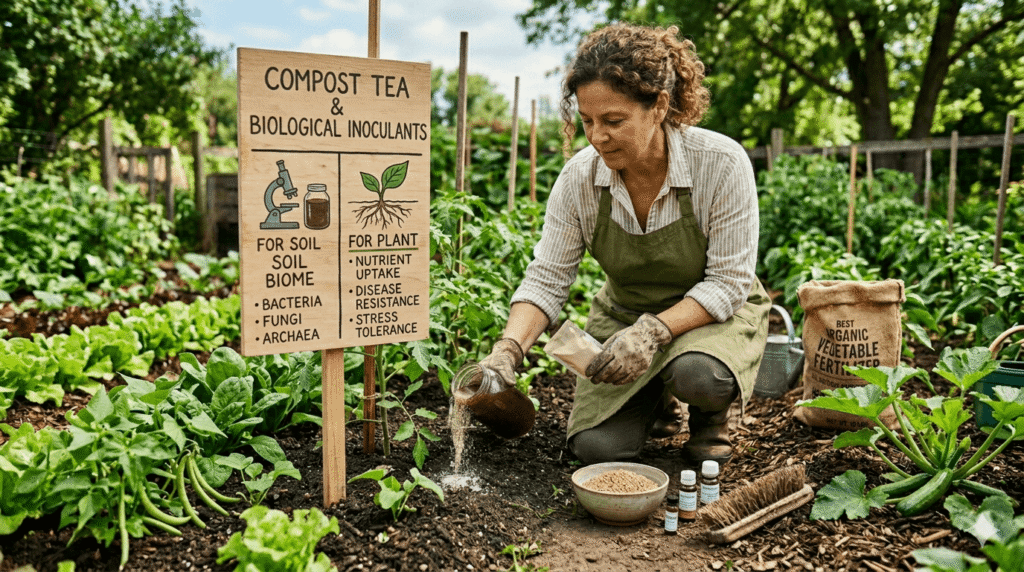
This is the category I am most excited about in 2026. The science of the soil microbiome has advanced enormously in the past decade, and the practical products now available to home gardeners reflect that progress. Compost teas, mycorrhizal inoculants, and multi-species bacterial consortia are no longer the preserve of specialist organic growers they are accessible, affordable, and genuinely effective.
Mycorrhizal fungi form symbiotic relationships with plant roots, extending the root system’s effective reach by orders of magnitude and accessing phosphorus, water, and trace minerals that roots alone cannot obtain. Beneficial bacteria fix atmospheric nitrogen, produce plant-growth hormones, and suppress soilborne pathogens.
These biological inputs do not replace NPK fertilization they amplify its effectiveness and reduce how much you need.
Apply mycorrhizal inoculants directly to transplant roots at planting.
Use compost tea or liquid biological products as a soil drench every three to four weeks throughout the season.
The returns compound over time: each season of biological investment makes the following season more productive.
- Best for: Long-term soil health, reducing overall fertilizer dependency
- Look for: Glomus intraradices or Rhizophagus irregularis for mycorrhizae; Bacillus subtilis and Trichoderma species for bacteria
- Application: At transplanting and as periodic soil drenches
How to Buy Fertilizer Wisely: Expert Buying Tips
The fertilizer market is large, competitive, and full of products that differ more in packaging than in performance. Here is how I evaluate fertilizer products when advising clients.
Read the Full Guaranteed Analysis, Not Just NPK
The guaranteed analysis panel on the back or side of the label lists every nutrient the product contains and guarantees, including secondary nutrients like calcium, magnesium, and sulfur, and micronutrients like iron, zinc, boron, and manganese.
A fertilizer that only lists NPK is telling you something important: it contains only NPK. For a food garden, that is usually not enough.
Understand the Ingredient Source
Organic fertilizers are required to list their ingredient sources: feather meal, blood meal, bone meal, kelp, fish hydrolysate, worm castings, and so on.
These sources influence not only nutrient content but also release rate, soil impact, and odor.
A fertilizer built primarily from feather meal and kelp will behave differently from one built around blood meal and bone meal, even if their NPK numbers are similar.
Understanding the ingredients helps you predict how a product will perform in your specific conditions.
Get a Soil Test Before You Buy
I consider a soil test a prerequisite for any serious vegetable fertilization program.
A basic test from your local cooperative extension office costs $15 to $30 and tells you your existing levels of nitrogen, phosphorus, potassium, calcium, magnesium, and pH. Without this information, you are guessing.
With it, you can choose fertilizers that fill genuine gaps rather than compounding excesses that are already in the soil.
I have seen gardens where soil phosphorus tested at triple the optimal level years of well-intentioned tomato fertilizer applications had built up a phosphorus excess that was now actively interfering with zinc and iron uptake.
The solution was not more fertilizer but a multi-season drawdown.
A $20 soil test would have prevented years of this problem.
Match the Fertilizer to the Season and Crop Stage
Buy fertilizers with a specific purpose in mind rather than a single product you plan to use for everything.
A balanced organic granular for soil preparation, a high-phosphorus option for transplanting and fruiting, and a liquid fertilizer for in-season feeding will cover all of your vegetable garden’s nutritional needs across the full season.
This targeted approach is more effective and ultimately more economical than applying one product indiscriminately throughout.
Prioritize Reputable Formulations Over Novelty
The fertilizer market is not immune to trends, and every season brings new products making dramatic claims. My general approach is to maintain healthy skepticism toward any product promising extraordinary results from proprietary blends with vague ingredient disclosures. Proven formulations with transparent ingredient lists and a track record of real-world performance will almost always outperform the latest novelty product.
A Practical Fertilizer Schedule for the Full Growing Season
Here is the fertilizer timeline I follow and recommend for productive vegetable gardens. Adjust based on your climate, crop selection, and soil test results.
- 4–2 weeks before planting: Incorporate compost and a balanced organic granular fertilizer into the top six to eight inches of soil. This establishes a nutritional and biological foundation before the season begins.
- At transplanting: Apply a dilute phosphorus-forward liquid fertilizer to the root zone. Add mycorrhizal inoculant directly to transplant roots. These steps dramatically reduce transplant shock and accelerate establishment.
- Weeks 2–6 (active vegetative growth): Apply a balanced or nitrogen-forward liquid fertilizer every 10–14 days. For leafy greens, maintain this program through harvest. For fruiting crops, begin the transition to lower nitrogen as flowering approaches.
- At first flower (fruiting crops): Shift to a lower-nitrogen, higher-phosphorus and potassium liquid fertilizer. This nutritional transition is one of the highest-impact interventions available to vegetable growers.
- Mid-season side dressing: For long-season crops like indeterminate tomatoes, side-dress with an organic granular fertilizer around the drip line six to eight weeks into the season to maintain nutritional support through the back half of production.
- Final four to six weeks: Reduce fertilization and allow plants to draw down their nutrient reserves. Excess late-season nitrogen delays fruit ripening, reduces fruit sugar content, and leaves plants poorly prepared for seasonal senescence.
The Most Common Fertilizer Mistakes — And How to Avoid Them
Across hundreds of garden consultations, the same errors appear with remarkable consistency. Recognizing and avoiding these five mistakes will immediately improve your results.
- Using high-nitrogen lawn fertilizer on vegetables. Lawn fertilizers are engineered for grass, which is harvested as foliage and benefits from sustained nitrogen. Applying them to fruiting vegetables suppresses fruit production, promotes excessive vegetative growth, and increases pest pressure. Keep lawn fertilizer on the lawn.
- Fertilizing dry soil. Applying granular fertilizer to dry soil concentrates fertilizer salts near the root zone, causing chemical burn that damages or kills roots. Always water soil thoroughly before applying granular fertilizers and water again immediately afterward to move nutrients into the root zone.
- Neglecting soil pH. Most vegetable crops thrive at a soil pH between 6.0 and 7.0. Outside this range, nutrients become chemically bound in forms that plants cannot absorb, regardless of how much fertilizer you apply. Correcting pH with agricultural lime or sulfur before fertilizing is not optional — it is foundational.
- Applying foliar sprays in midday sun. Liquid droplets on leaves in direct sunlight act as miniature lenses and can cause significant scorch damage. Foliar applications should always be made in early morning or evening when temperatures are cooler and the sun is at a lower angle.
- Over-fertilizing with the best intentions. More fertilizer is not better fertilizer. Excess nitrogen suppresses fruiting and attracts pests. Excess phosphorus locks out zinc and iron. Excess potassium interferes with calcium and magnesium uptake. Start at the lower end of recommended rates, observe your plants’ response, and adjust incrementally.
Closing Thoughts: Feeding the Garden That Feeds You
After fifteen years in this profession, I remain genuinely excited by the science of plant nutrition. We understand more about the mechanisms of nutrient uptake, soil biology, and the plant-microbiome relationship than any previous generation of agronomists, and that knowledge is increasingly accessible to home gardeners who want to use it.
The gardeners who produce the most remarkable vegetables are not necessarily those with the largest budgets or the most elaborate setups. They are the ones who pay attention — to their soil, to their plants’ changing needs across the season, and to the feedback that a well-tended garden provides constantly, if you know how to read it.
Invest in understanding your soil. Choose fertilizers that address what your plants actually need at each growth stage. Build your soil biology season by season. And give yourself permission to make mistakes — every failure in the garden is a lesson that will serve you for the rest of your growing life.
My father never had a soil test or a certified crop adviser. But he understood that the garden rewards attention and patience above all else. That remains the most important thing I know.
About the Author: Daniel Okafor is an agronomist and vegetable production specialist with fifteen years of experience advising commercial and home growers across West Africa, Europe, and North America. He holds a BSc in Agronomy and an MSc in Soil Science, and has consulted on vegetable production projects from small urban farms to large-scale market garden operations.