
Best Fertilizer for Blueberry Bushes in Pots (2026): Expert Picks and Proven Results
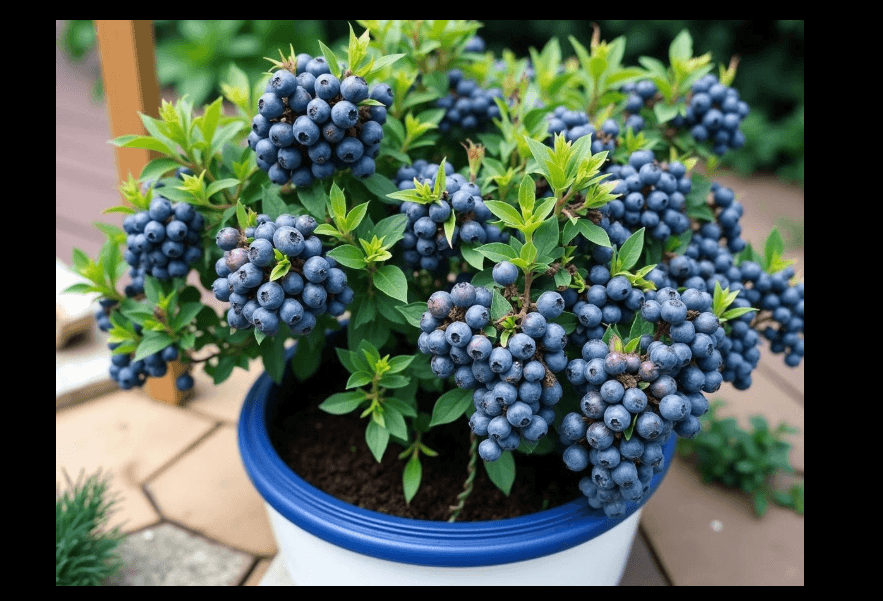
I fed my potted blueberries every single week for two full seasons. They looked healthy. Lush, even. And they gave me almost nothing.
Eleven berries. Total. From three plants. I counted them.
The problem was not effort. Watering was not the issue. Sunlight was not the problem either. The real culprit was the fertilizer — specifically, the fact that I was using the wrong kind and destroying my soil pH without realizing it.
Here is what nobody explains clearly enough: potted blueberries do not behave like any other container fruit. They are extraordinarily sensitive to pH. They need acid-forming nutrients specifically — not just any NPK ratio. And in a container, with no surrounding soil to buffer mistakes, every wrong application compounds fast.
Once I understood the actual chemistry and switched to the right products at the right times, the same three plants gave me over 120 berries the following season. Deep indigo. Genuinely sweet. No extra effort — just the right inputs.
This guide covers exactly what changed, what I use now, and the mistakes I see other growers repeat every spring.
Why Fertilizing Blueberries in Pots Is Genuinely Different
In the ground, blueberries have a huge buffer. The surrounding soil absorbs excess nutrients, moderates pH shifts, and holds moisture consistently.
In a pot, there is no buffer. Every time you water, nutrients drain through. Every time you add the wrong fertilizer, pH swings. The plant is completely dependent on what you put in.
I learned this the hard way after using the same 10-10-10 balanced granular on my container blueberries that I was using on my tomatoes. Excess nitrogen drove my soil alkaline. My plants started yellowing between leaf veins — a classic sign of iron chlorosis caused by high pH preventing iron uptake. Without the right pH, a plant simply cannot absorb iron even when it is present in the soil.
Using general-purpose or vegetable fertilizers. These are almost always pH-neutral or pH-raising. Blueberries need soil pH between 4.5 and 5.5. Anything above 6.0 locks out nutrients the plant cannot absorb regardless of how much you feed it.
The Acid Problem Nobody Mentions
Blueberries belong to the Ericaceae family — the same family as azaleas, rhododendrons, and heather. Every plant in this family has the same fundamental need: acidic soil.
In containers, the potting mix naturally drifts toward neutral pH over time. Water from most municipal sources is slightly alkaline. Regular fertilizers accelerate this. Within a single growing season, a container that started at pH 5.0 can drift to 6.5 or higher without you noticing anything obvious — until the berries stop forming or the leaves go pale.
This is why the fertilizer you choose matters enormously. The best fertilizer for blueberry bushes in pots is not just about nitrogen, phosphorus, and potassium. It is specifically about products that are acid-forming — meaning they actively lower pH as they break down, not just feed the plant.
What NPK Numbers to Look For
Most people get confused here because different fruit plants want different ratios. For blueberries specifically, the pattern is straightforward once you understand it.
Nitrogen: Moderate. Enough to support leafy growth and berry development, but not so high that it pushes all energy into leaves.
Phosphorus: Moderate to low. Blueberries have fine hair roots that are highly efficient at phosphorus absorption. Too much phosphorus in a container can actually lock out other micronutrients.
Potassium: Equal to or slightly higher than nitrogen. Potassium drives berry sweetness, disease resistance, and cold hardiness.
Something in the range of 4-3-4 to 8-5-6 is ideal. The exact numbers matter less than the source — you need ammonium-based nitrogen, not nitrate-based. Ammonium lowers pH. Nitrate raises it.
Look at the label for the nitrogen source. “Ammonium sulfate” or “feather meal” are acid-forming and ideal. “Calcium nitrate” or “potassium nitrate” are pH-raising. This one detail explains why two fertilizers with identical NPK numbers can produce completely different results in a blueberry container.
The Best Fertilizers for Blueberry Bushes in Pots
Espoma Holly-Tone 4-3-4
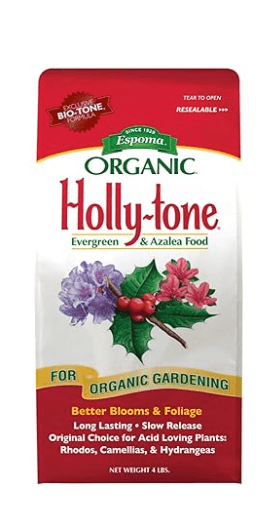
Holly-Tone is the product I recommend to anyone asking about potted blueberries. I have been using it for four seasons now and it consistently delivers. The 4-3-4 ratio is well-suited to blueberries specifically, and more importantly, it uses feather meal and cottonseed meal as nitrogen sources — both are acid-forming and slow-releasing.
The granular format is forgiving. Applied twice a year — early spring and after harvest — it feeds steadily without burning roots or spiking pH. One 18-pound bag feeds three to four large container blueberries for a full season for about $20.
- Acid-forming nitrogen sources that actively lower pH over time
- Slow-release granular — zero burn risk even in small containers
- Contains beneficial microbes that improve root health long-term
- One of the most affordable organic options per season
- Works for azaleas, rhododendrons, and camellias too
The one downside: Slow. If your pH is very high right now and your plant is struggling, Holly-Tone will not fix it quickly. Pair it with a soil acidifier like granular sulfur or aluminum sulfate for a faster correction.
Check Price & Availability on AmazonDr. Earth Acid Lovers Organic Fertilizer 4-5-4
This is what I personally use. It costs more than Holly-Tone — around $22 for a 4-pound bag — but the probiotic formula containing beneficial soil bacteria and mycorrhizal fungi makes a real difference in container growing over time.
Pots are isolated ecosystems. The soil biology degrades faster than in-ground beds. Dr. Earth rebuilds that biology season by season. By my third year using it on the same plants, the root system health was visibly better when I repotted — thick, white, extensive roots instead of the sparse, brownish ones I saw in year one.
- Probiotic formula with mycorrhizal fungi for root health
- Slightly higher phosphorus (5) supports stronger fruiting
- USDA-certified organic, no synthetic ingredients
- Long-term soil biology improvement compounds across seasons
Best for: Growers who are in it for the long haul with the same container plants for 3+ years. The cumulative benefit is real but takes time to show.
Check Price & Availability on AmazonMiracle-Gro Azalea, Camellia & Rhododendron Plant Food 30-10-10
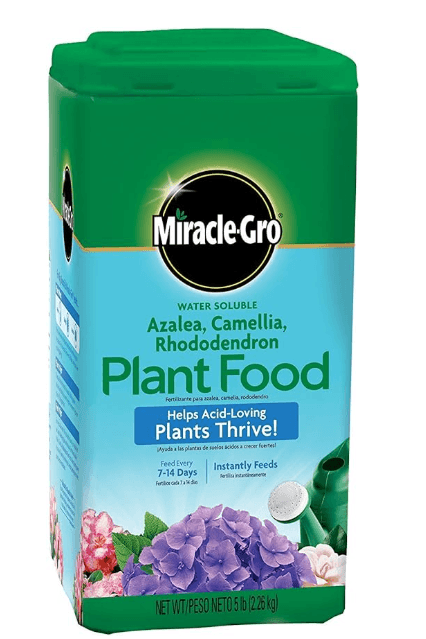
Before you panic at the 30-10-10 ratio — this is ammonium-based nitrogen, not nitrate-based. It is specifically formulated for acid-loving plants and will acidify the soil as it feeds. It is the product I reach for when I see yellowing leaves and I need a correction within two weeks rather than two months.
Water-soluble formula means it hits the roots immediately. The plant response is visible fast — new growth comes in healthy green within ten to fourteen days of the first application.
- Water-soluble for immediate root uptake
- Ammonium sulfate base actively acidifies soil
- Ideal rescue treatment for pH-stressed plants
- Inexpensive and widely available
The 30-10-10 ratio is high. In a pot with no buffer, this can burn roots and cause salt buildup if used at full label rate. I always dilute to half strength and apply once every three weeks during the growing season — never more frequently than that.
Side-by-Side Comparison
| Product | NPK | Type | Best For | Approx. Price |
|---|---|---|---|---|
| Espoma Holly-Tone Top Pick | 4-3-4 | Organic granular | Most growers, spring + fall | ~$20 / 18 lb |
| Dr. Earth Acid Lovers | 4-5-4 | Organic granular | Long-term container growers | ~$22 / 4 lb |
| Miracle-Gro Azalea Food | 30-10-10 | Water-soluble | Fast rescue, pH correction | ~$10 / 1.5 lb |
When and How to Fertilize Potted Blueberries
Timing is the part most articles get wrong or gloss over entirely. I made the mistake in my first season of fertilizing in early March when I first got excited about the season. In my climate, the plant was barely awake. The nutrients sat in the pot and leached out before the roots were active enough to absorb them.
The Right Schedule
First application: Wait until the buds break and you see 1 to 2 inches of new green growth. In most temperate climates this is late March to early April. Apply your acid-forming granular at the drip line, not against the stem.
Second application: Six weeks after the first. The plant is in full growing mode and actively forming fruit. This is when I sometimes switch to a water-soluble formula for faster uptake.
Third and final application: Immediately after harvest — not before fall. Blueberries need to harden off properly before winter.
Stop all fertilizing by late July in most northern climates, or by August in warmer zones. This is firm.
Water thoroughly the day before applying granular fertilizer. Dry soil causes nutrients to sit on the surface instead of moving toward roots. Wet soil helps granules dissolve and travel down to the root zone within 24-48 hours. This simple step measurably improves how fast you see a growth response.
Application Method for Containers
Never pour granules directly against the main stem. The crown of a blueberry is sensitive to concentrated fertilizer and will burn. Scatter granules starting two inches away from the stem and working outward to the edge of the pot. Work them lightly into the top inch of soil with your fingers. Water immediately and thoroughly after application.
The 5 Mistakes That Kill Potted Blueberry Results
Mistake 1: Wrong Potting Mix to Begin With
Standard potting mix runs around pH 6.0 to 6.5. That is already outside the ideal range for blueberries before you add a single drop of water. Start with a mix specifically designed for acid-loving plants, or blend regular potting mix with ericaceous compost and coarse pine bark at roughly 50-30-20. No amount of acid-forming fertilizer will compensate for starting in the wrong medium.
Mistake 2: Skipping the pH Test
A basic soil pH meter costs $12 online. Test at the start of each season. If pH is above 5.5, acidify before fertilizing. Fertilizing a plant in too-alkaline soil is wasted effort.
Mistake 3: Fertilizing Too Late in the Season
A late August or September application of any nitrogen-containing fertilizer pushes soft new growth that will not harden before frost. That new growth dies. The plant uses enormous energy replacing it the following spring instead of putting energy into fruit.
Mistake 4: Overwatering and Flushing Nutrients Out
Overwatering does double damage: it stresses roots and flushes nutrients straight through the drainage holes before they can be absorbed. Soil should be moist but not saturated. In hot weather check daily but water only when the top inch of the mix feels dry to the touch.
Mistake 5: Using a Single Plant Variety
Most blueberry varieties are self-fertile but produce significantly more fruit with a second compatible variety nearby. I had one Bluecrop plant in a pot for two years. Added a Patriot variety in year three. Same fertilizing routine. Berry count nearly doubled.
Realistic Costs for a Season of Container Blueberry Feeding
Budget approach (Holly-Tone only): One 18-pound bag at around $20 feeds 3 to 4 containers for a full growing season. That works out to $5 to $7 per plant per year.
Mid-range approach (Holly-Tone plus soil acidifier): Add a $12 bottle of pH-lowering acidifier applied once in early spring. Total: about $8 per plant per year.
Premium approach (Dr. Earth plus water-soluble mid-season boost): About $12 per plant per year. A single healthy container blueberry can produce 2 to 4 pounds of berries per season — $8 to $16 worth of fruit from a $10 annual fertilizer investment.
Advanced Tips Most Articles Miss
Ammonium Sulfate as a pH Emergency Tool
If your pH has shot above 6.5, granular sulfur or aluminum sulfate applied directly to the soil surface is faster than any fertilizer at lowering pH. I use aluminum sulfate at 1 tablespoon per gallon of pot size, worked into the surface and watered in. pH correction happens within two to three weeks.
Adding Acid Mulch to Containers
A two-inch layer of pine bark chips or pine needle mulch on top of the pot helps maintain acidic conditions between fertilizer applications. It breaks down slowly and acidifies the top layer of soil. It also regulates moisture loss in hot weather.
Foliar Feeding for Fast Correction
When I see early signs of iron or magnesium deficiency mid-season, a foliar spray of chelated iron or Epsom salts bypasses the soil entirely. Chelated iron foliar spray at half label strength, applied in the evening to avoid leaf scorch, shows visible improvement within five to seven days.
Repotting and Fertilizer Timing
Do not fertilize a blueberry bush for the first six weeks after repotting into fresh mix. Fresh potting medium already contains starter nutrients and the roots need time to establish in the new medium before you add more.
Frequently Asked Questions
The Takeaway
Get the pH right first. Everything else follows from that. A $12 soil meter is the most valuable tool in potted blueberry growing — more valuable than any specific fertilizer brand.
Use acid-forming fertilizers exclusively. No general-purpose products, no lawn food, no high-nitrate formulas. Espoma Holly-Tone or Dr. Earth Acid Lovers are where I would start for most people.
Be patient with organic products. They improve your growing medium season over season. By year three of consistent organic feeding, the same plant in the same pot will outperform what it did in year one simply because the soil biology has improved.
Stop fertilizing in late summer. The most common avoidable damage I see in container blueberries comes from nitrogen-induced tender growth that winter destroys. Get these basics right and a 15-gallon pot can give you a genuinely impressive harvest for a decade or more.