
Cedar Raised Garden Bed: What Actually Makes One Last 15 Years (and What Ruins It in 3)

Two cedar raised garden beds went into my yard the same spring.
One still looks solid today.
The other had soft, crumbling corners by its fourth summer.
Same species of wood, same soil, same watering.
The difference was something I didn’t even know to look for when I bought the boards.
If you’re thinking about a cedar raised garden bed, that’s the part nobody talks about, and it’s what this guide is really about.
Quick Answer
- A well built cedar bed lasts about 10 to 15 years. A cheap one can fail in 3 to 5.
- Buy boards that are mostly dark reddish heartwood. Pale cream sapwood rots fast.
- Choose boards at least 1.5 inches thick (2x lumber). Thin fence boards warp and split.
- Use stainless steel screws. Cedar stains and eats through cheap steel.
- Never seal or stain the inside of a food bed.
- A DIY 4×8 cedar bed, 11 inches tall, costs roughly $180 to $265 in lumber and hardware.
- If you want a bed taller than 17 inches, metal often costs less and lasts longer.
This guide contains affiliate links. If you buy through them, I may earn a small commission at no extra cost to you.
Why I Still Choose Cedar (Even After Growing in Metal)
I grow in both cedar and metal beds, so I’m not loyal to one material.
Cedar wins for me in a few places.
It looks right next to a wood fence or a deck.
It doesn’t heat up in the afternoon sun the way thin metal walls can.
It’s easy to cut, so I can build a bed that fits an awkward corner exactly.
And honestly, I like the smell when I’m cutting it.
But cedar is not magic.
I used to think “cedar” on the label meant the bed would last forever.
It doesn’t.
How long it lasts depends on which part of the tree the boards came from, how thick they are, and how you put them together.
Not All Cedar Is the Same
When you walk into a lumber yard or browse kits online, “cedar” can mean several different things.
| Cedar Type | Rot Resistance | Where You’ll See It | My Take |
|---|---|---|---|
| Western red cedar | High (heartwood) | Most US lumber yards and good kits | The standard choice for a cedar raised bed |
| Northern white cedar | High | Northeast US, some local mills | Lighter color, very durable, harder to find |
| Alaskan yellow cedar | Very high | Specialty suppliers | Excellent, but usually priced like a luxury |
| “Cedar tone” or cedar stained pine | Low | Cheap kits and big box stores | Not cedar at all. Read the label twice |
Heartwood vs sapwood: the detail that decided my two beds
This is what happened to my failed bed.
A cedar log has a dark center called the heartwood and a pale outer ring called the sapwood.
The heartwood holds the natural oils that fight rot and insects.
The sapwood has almost none of that protection.
The USDA Forest Products Laboratory Wood Handbook makes the same point: decay resistance comes from the heartwood, while sapwood of nearly every species rots easily.
My bad bed was built from boards with wide cream colored stripes along the edges.
Those stripes were sapwood, and they were exactly where the rot started.
Now I dig through the pile and pick boards that are dark reddish brown edge to edge.
It takes ten extra minutes, and it’s the best free upgrade you can give a cedar bed.
Knotty vs clear grade
Clear cedar has no knots and costs a lot more.
For a garden bed, knotty grade is completely fine.
Just skip boards with loose knots or knots right at the ends, where you’ll be driving screws.
What to Look For When Buying a Cedar Raised Garden Bed
Whether you buy a kit or loose boards, these are the things I check now.
Board thickness matters more than the price tag
Many cheap cedar kits use boards around 5/8 to 3/4 inch thick.
That’s fence picket territory.
They look fine in photos, but once they’re full of wet soil they cup, bow, and split at the screws.
I wouldn’t buy anything thinner than 1 inch, and I prefer standard 2x boards, which are 1.5 inches thick.
Thicker boards also simply take longer to rot through.
How the corners are joined
Corners are where cedar beds fail first.
Look for corner posts, metal corner brackets, or interlocking joints with long screws.
Kits that use small slide in grooves with no posts tend to loosen after a season or two.
Rough sawn or smooth
Rough sawn cedar is a little thicker and often cheaper.
Smooth (surfaced) cedar looks neater.
Either works. I use rough sawn for beds in the back of the yard and smooth for the ones near the patio.
Kit vs DIY
| Cedar Kit | DIY From Lumber | |
|---|---|---|
| Setup time | 30 to 60 minutes | 2 to 4 hours |
| Board thickness | Often thin, check the specs | You choose, usually 1.5 inches |
| Wood quality | Mixed heartwood and sapwood, you can’t pick | You hand pick every board |
| Size options | Fixed sizes | Any size you need |
| Best for | Small beds, quick setup | Long lasting beds, custom fits |
If you go the DIY route, I walk through the full build in my guide on how to build a raised garden bed.
How to Set Up a Cedar Raised Garden Bed So It Lasts
These are the steps I follow now, and they’re the reason my newer beds still look tight.
-
Hand pick heartwood boards
Choose boards that are dark from edge to edge.
Sight down each board to check that it isn’t twisted.
A twisted cedar board will not straighten out once the screws are in.
-
Use stainless steel screws
Cedar contains natural acids that react with plain and cheaply coated steel.
I learned this when black streaks ran down from every screw on my first bed within a few months.
Stainless steel screws cost more, but they don’t stain and they don’t corrode away.
-
Drill pilot holes, every time
Cedar is soft and splits easily, especially near the ends.
A pilot hole takes five seconds and saves a board.
-
Add corner posts and a center brace
Use 4×4 cedar posts inside each corner.
On any side longer than 6 feet, add a brace across the middle so the long boards don’t bow outward.
-
Lift the bottom board off wet ground
The bottom board rots first because it stays wet.
Set the bed on a level bed of gravel or on flat pavers along the edges, so the wood isn’t sitting in mud.
Only under the boards, not inside the bed.
-
Line the bottom, not the walls
Lay plain cardboard over the grass inside the bed.
Add hardware cloth first if you have gophers or voles.
-
Fill with a good soil mix
I use about 60 percent screened topsoil and 40 percent compost.
If your native ground is heavy clay, make the bed taller. I explain why in my guide to the best raised garden bed for clay soil.
Buy one extra board.
Almost every time, I find one board with a split end or a hidden twist after I get home.
Having a spare saves a second trip.
Mistakes That Shorten the Life of a Cedar Bed
1. Sealing or staining the inside
I see this all the time.
Most stains and sealers aren’t made for soil that grows food.
They also trap moisture in the wood instead of letting it dry out.
Leave the inside bare.
2. Lining the walls with plastic
It sounds like a smart way to protect the wood.
In my experience, plastic holds water against the boards and the wood behind it stays damp all season.
If you want a barrier, use breathable landscape fabric, or skip it entirely.
3. Buying a kit based on photos only
Always check the board thickness in the specs.
A beautiful kit with 5/8 inch boards is a 3 year bed, not a 15 year bed.
4. Using cedar mulch or fresh cedar chips inside the bed
Fresh cedar contains compounds that can slow seed germination.
It’s fine as a frame. I just don’t mix fresh cedar sawdust or chips into the soil where I sow seeds.
5. Expecting the color to stay
New cedar is a rich reddish orange.
Within a year in full sun, it turns silver gray.
That’s only on the surface. It doesn’t mean the wood is rotting.
6. Building it too tall in wood
A 24 or 32 inch cedar bed holds an enormous amount of soil pressure.
It needs heavy internal bracing, and the lumber cost climbs fast.
This is where I usually switch to metal.
Watch out for listings that say “cedar finish” or “cedar color.”
These are usually pine or fir stained to look like cedar.
They rot in a few years, and the stain is not something you want next to your vegetables.
Is Cedar Safe for Vegetable Gardens?
Yes.
Untreated cedar is one of the most common choices for food beds for exactly this reason: it resists rot naturally, with no chemical treatment.
The natural oils that protect the wood stay mostly in the wood.
I’ve grown tomatoes, lettuce, carrots, and herbs in cedar beds for years without any problem.
The only things to avoid are stains, sealers, and painted reclaimed cedar of unknown origin.
How Much Does a Cedar Raised Garden Bed Cost?
Cedar prices move around a lot by region, so treat these as ballpark US numbers.
| Option (4×8 size) | Typical Cost | Realistic Lifespan |
|---|---|---|
| Thin board cedar kit (5/8 to 3/4 inch) | $120 to $200 | 3 to 6 years |
| Thick board cedar kit (1 inch or more) | $250 to $450 | 8 to 15 years |
| DIY, 11 inches tall, 2×6 cedar | $180 to $265 in lumber and screws | 10 to 15 years |
| DIY, 16 to 17 inches tall, 2×6 cedar | $260 to $380 in lumber and screws | 10 to 15 years |
| Soil and compost to fill (11 inch bed) | $60 to $220, bulk vs bagged |
Here’s the honest math I did before my last purchase.
An 11 inch DIY cedar bed lasting 12 years costs me around $20 per year for the frame.
A thin $150 kit lasting 4 years costs me about $37 per year, plus the hassle of rebuilding and reshoveling soil.
Cheap cedar is the expensive option in the long run.
Cedar vs Metal Raised Garden Beds
This is the comparison I get asked about the most.
| Cedar | Metal (Zinc Coated Steel) | |
|---|---|---|
| Lifespan | 10 to 15 years with heartwood | 15 to 20 years or more |
| Look | Warm, natural, turns gray | Modern, many colors |
| Soil temperature | Stays cooler and steadier | Warms faster in spring |
| Custom sizes | Easy to cut to any size | Limited to kit layouts |
| Cost at 11 inches tall | Usually cheaper | Similar or more |
| Cost at 17 to 32 inches tall | Expensive, needs heavy bracing | Usually cheaper per inch of height |
| Bowing over time | Possible without a center brace | Rare with good kits |
My rule is simple.
For low beds, custom sizes, or a natural look, I build in cedar.
For anything 17 inches or taller, I buy metal.
Prefer Metal? Two Alternatives to a Cedar Bed
Cedar isn’t the right fit for everyone.
If you’d rather skip the wood completely and go with metal, these are the two I’d pick as an alternative.
Both make the most sense for a bigger garden, the kind where a cedar build would mean a whole weekend and a truck full of lumber.
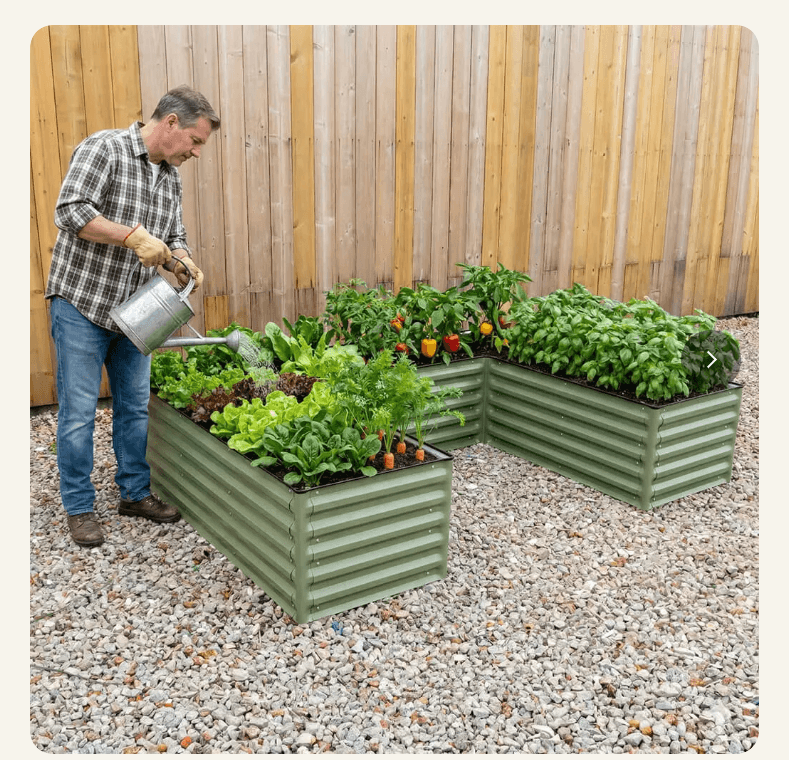
Vegega 17″ Tall U Shape Rectangle Metal Raised Garden Bed
| Price checked | $459.95 |
| Height | 17 inches |
| Shape | U shape, open in the middle so you can step inside |
| Best for | Lots of growing space without ever stepping on the soil |
What I Like
- You can reach every plant from the center path
- A cedar U shape needs extra corners, posts, and cuts, which is where wood beds fail first
- Fits nicely against a fence or in a yard corner
Watch Out For
- Needs a lot of soil to fill all three sides
- Takes up more floor space than a simple rectangle

Vegega 17″ Tall Ring Shape Metal Raised Garden Bed
| Price checked | $1,100.95 |
| Height | 17 inches |
| Shape | Large ring that wraps around a central sitting or work area |
| Best for | Turning a garden into an outdoor space you actually sit in |
What I Like
- Creates a full garden room, not just a planting box
- Curves like this are almost impossible to build in cedar
- Huge planting area for flowers, herbs, and vegetables together
Watch Out For
- A big investment, and it needs a lot of soil
- Plan the spot carefully, because it won’t move once filled
I compared more metal options in my guide to the best metal raised garden bed for vegetables, and the full lineup in my Vegega raised beds review.
Advanced Tips for Cedar Beds Most Guides Skip
Save your best boards for the bottom row
The bottom row sits closest to wet soil, so it always rots first.
I put the darkest, thickest heartwood boards on the bottom and the ones with a little sapwood on top.
The top row dries out fast after rain, so it forgives a less than perfect board.
It costs nothing and adds years to the bed.
Cap the top edge
A flat 2×6 screwed along the top of the walls keeps rain off the exposed end grain.
End grain soaks up water like a straw, so covering it slows rot at the corners.
It also gives you a seat while you weed.
Let the outside breathe
If you want to slow the graying, a coat of raw linseed oil on the outside only is enough.
I tried a film forming deck stain once. It peeled within two years and looked worse than plain gray cedar.
Keep mulch off the boards
Pull wood chip mulch in the paths a few inches away from the bed walls.
Mulch piled against cedar keeps the bottom board wet.
Top up the soil every spring
Cedar beds don’t hold nutrients any differently than metal ones, but small beds wear out fast.
Top up with an inch or two of compost each spring and feed heavy feeders like tomatoes during the season.
I covered what works in my guide to the best fertilizer for vegetables.
Buy in fall or winter
Lumber yards are quieter outside of spring.
That’s when I have the time and space to dig through the pile for the best heartwood boards.
Frequently Asked Questions
How long does a cedar raised garden bed last?
About 10 to 15 years if the boards are thick heartwood and the bottom stays out of standing water.
Thin kits with lots of sapwood often last only 3 to 6 years.
Should I treat or seal my cedar raised bed?
Not on the inside.
If you want to slow the color change, use raw linseed oil on the outside only.
Is cedar better than redwood for raised beds?
Both resist rot well when you buy heartwood.
Redwood is mostly sold on the West Coast and usually costs more, so cedar is the easier choice for most people.
Is cedar better than pressure treated wood?
Modern treated lumber lasts a long time, but it isn’t allowed in certified organic growing.
Cedar gives you long life with no chemical treatment at all, which is why I use it for food beds.
Why is my cedar bed turning gray?
Sunlight breaks down the color on the surface.
It’s normal, it doesn’t mean rot, and the wood underneath is still red.
How deep should a cedar raised bed be?
11 to 12 inches works for most vegetables.
Go 16 to 17 inches for carrots, potatoes, or poor native soil.
Can I use cedar fence pickets to build a raised bed?
You can, but they’re usually 5/8 inch thick.
They’ll bow and split quickly, so expect a short lifespan unless you add plenty of posts.
The Bottom Line
A cedar raised bed is worth it when you buy thick heartwood boards and build it right.
Pick dark boards, use stainless screws, brace the long sides, and keep the bottom out of the mud.
For low beds and custom shapes, cedar is still my favorite.
For a big garden or a shape you could never cut from boards, the Vegega U shape bed saves you the build and the rot.
Either way, choose the bed you’ll actually set up this season and start growing.